
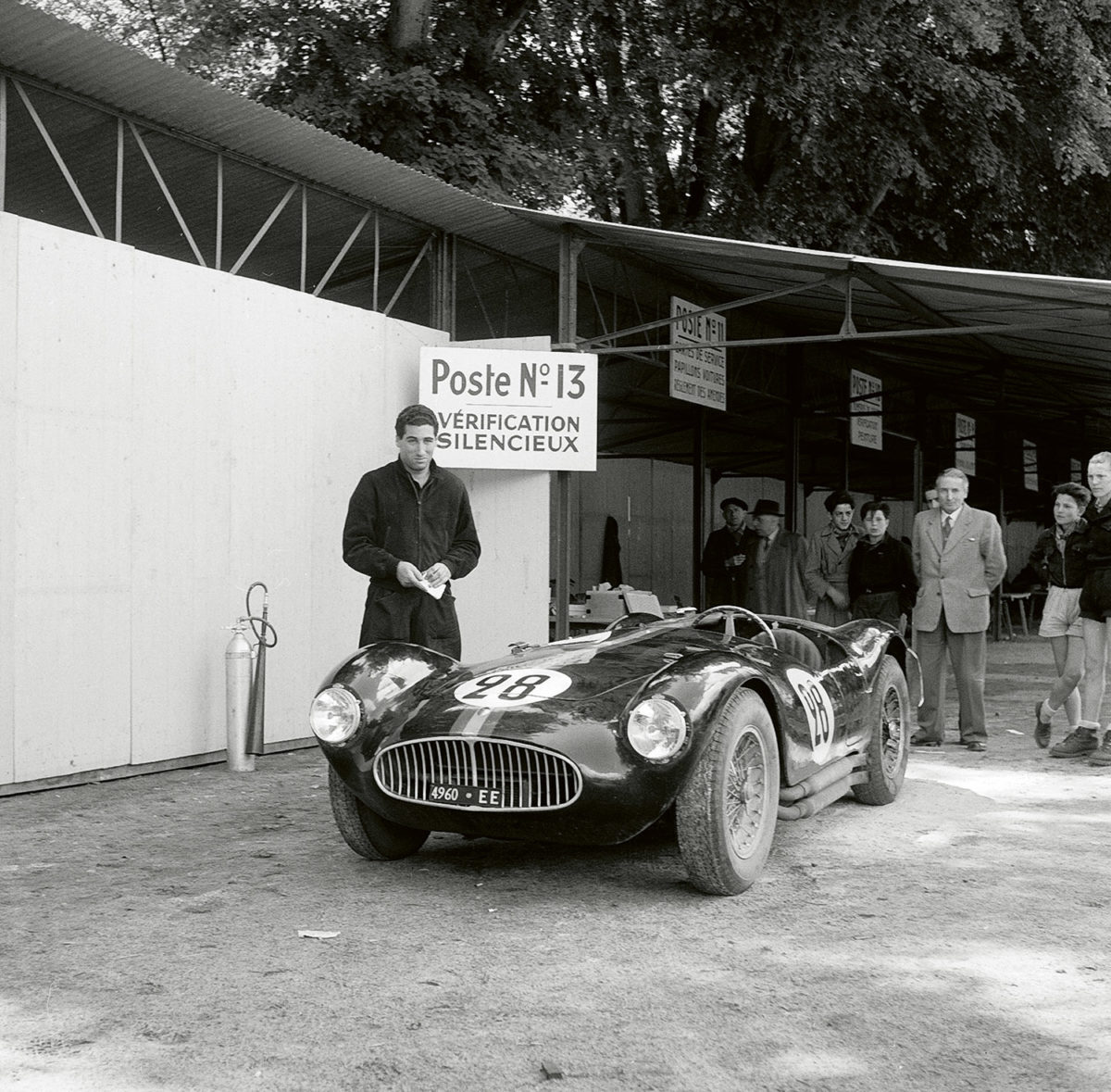
Portago with his black Maserati, chassis 2076 at Le Mans in 1954. The book is filled with great shots like this.
Review by Pete Vack
Photos from the book with permission
The Maserati A6GCS is the fifth book in the Dalton Watson series on Maserati authored or co-authored by Walter Bäumer.
Two of the Dalton Watson books were a first and second edition of the Maserati 300S. The other three books deal with an important and yet often imprecise A6 series of cars, originally taken over from the Maserati brothers after they left to form OSCA in 1947. The Maserati A6G 2000 Zagato, covering 22 Zagato-bodied chassis, was published in 2013; a similar volume, the Maserati A6G 2000 addressing the 54 Frua, Pinin Farina, Vignale and Allemano-bodied cars was completed in 2021, and this year the Maserati A6GCS covering 53 of the Series II sports racing cars was published.
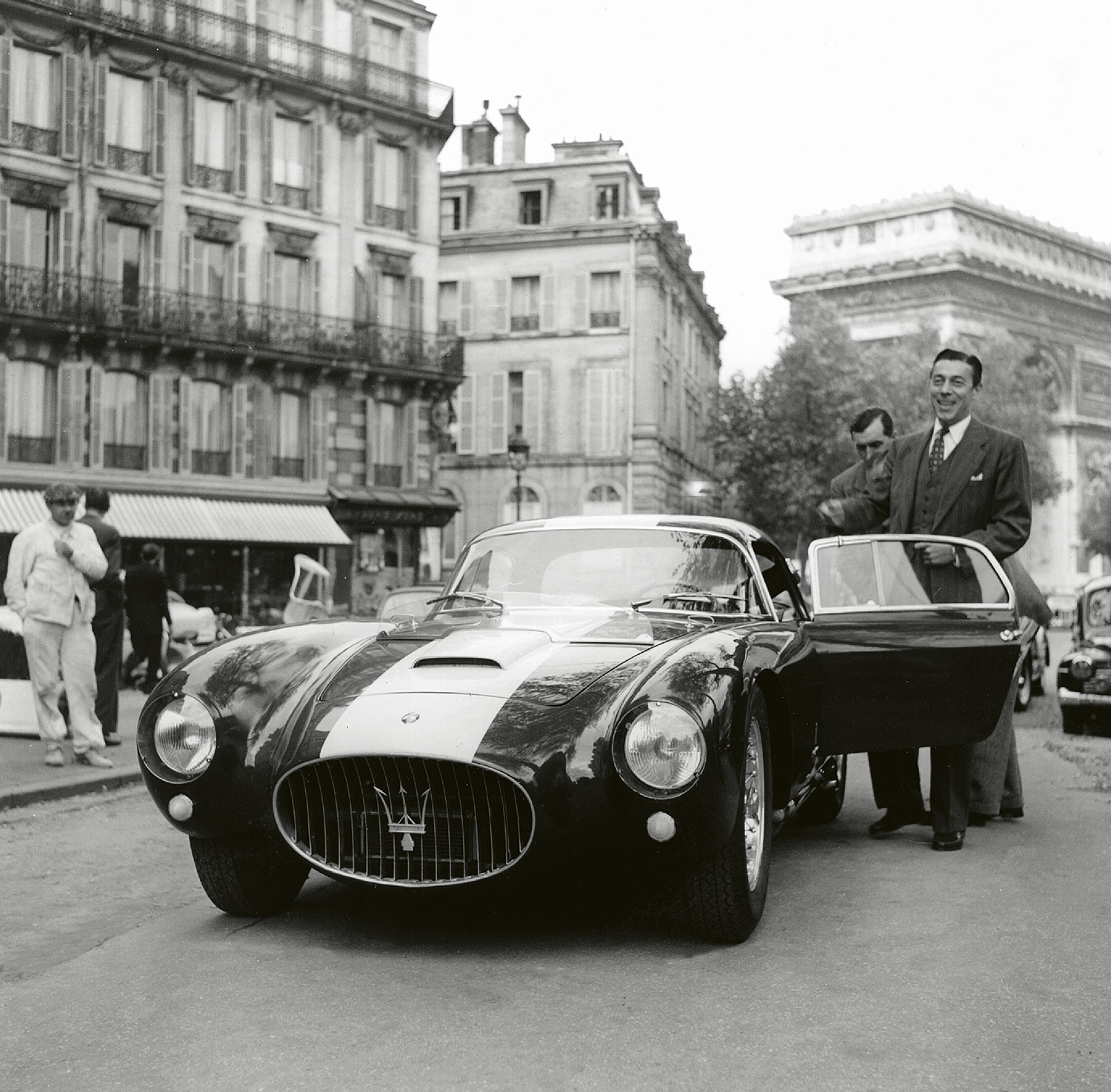
French Maserati dealer Colonel Simone is standing next to the new Pinin Farina coupe, chassis 2059. Just behind the car is Harry Schell’s restaurant in Paris. The book addresses all of the Pinin Farina A6GCS coupes.
There are a few left out; one-off A6 cars, the A6 1500 and the A6GCM F1 and F2 cars, plus a focused look at the first series A6GCS cars, listed in the most recent book but not detailed. We asked Walter if he might be working to fill that gap. “Well, I am thinking about the next Maserati book project.” However, he did not want to be specific about the types of Maserati he will write about.
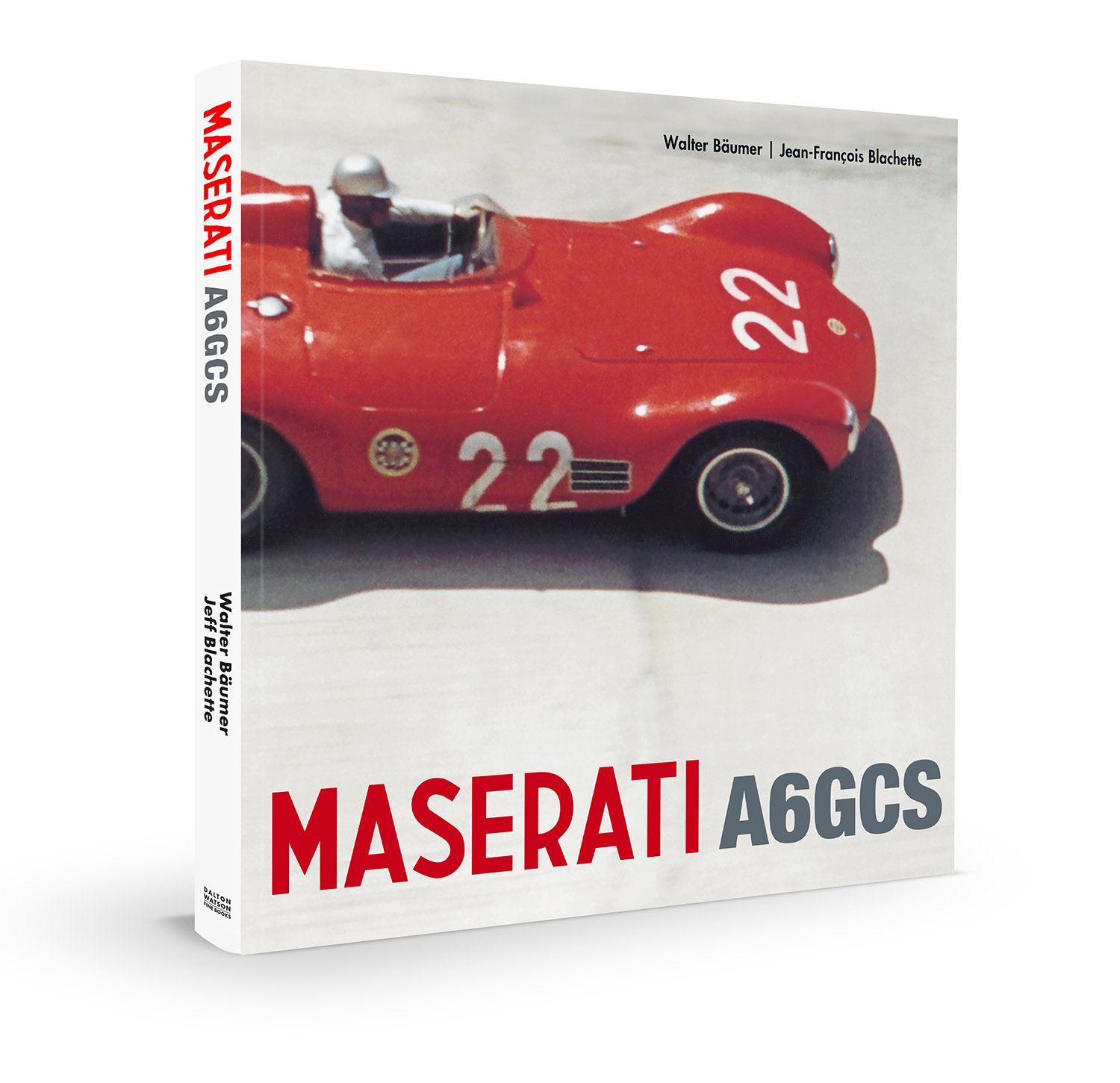
It might be a good idea to buy the two Maserati A6G books that are still available from Dalton Watson. The Zagato book is already sold out and now quite expensive.
In creating the latest book, Bäumer was ably assisted by French Maserati historian Jean François (Jeff) Blachette and focused on listing the races and results for each one of the cars by chassis number. Sometimes historians forget what a help model makers and collectors can be. To make their models as accurate as possible, they must have a lot of references and have an obsession with details (see One Family, Five Fantuzzis). Bäumer told us “Jeff Blachette was a huge help, for as a model maker of 1:43 cars, he has a great eye for details. He sorted many mysteries with the cars and identifying them.” Together, they combined their personal photo archives while Jeff found a lot more photos in French archives. “I simply could not have done this without Blachette,” says Bäumer.
The results are impressive, particularly as many of the races were very obscure events and hillclimbs in the mid-fifties. And one might think that in this day of everything on the Internet, such a task might be easy, but we suspect that it can be frustrating. According to Bäumer, “It was very complicated to sort out these numerous races associated to the A6GCS (or not…).”
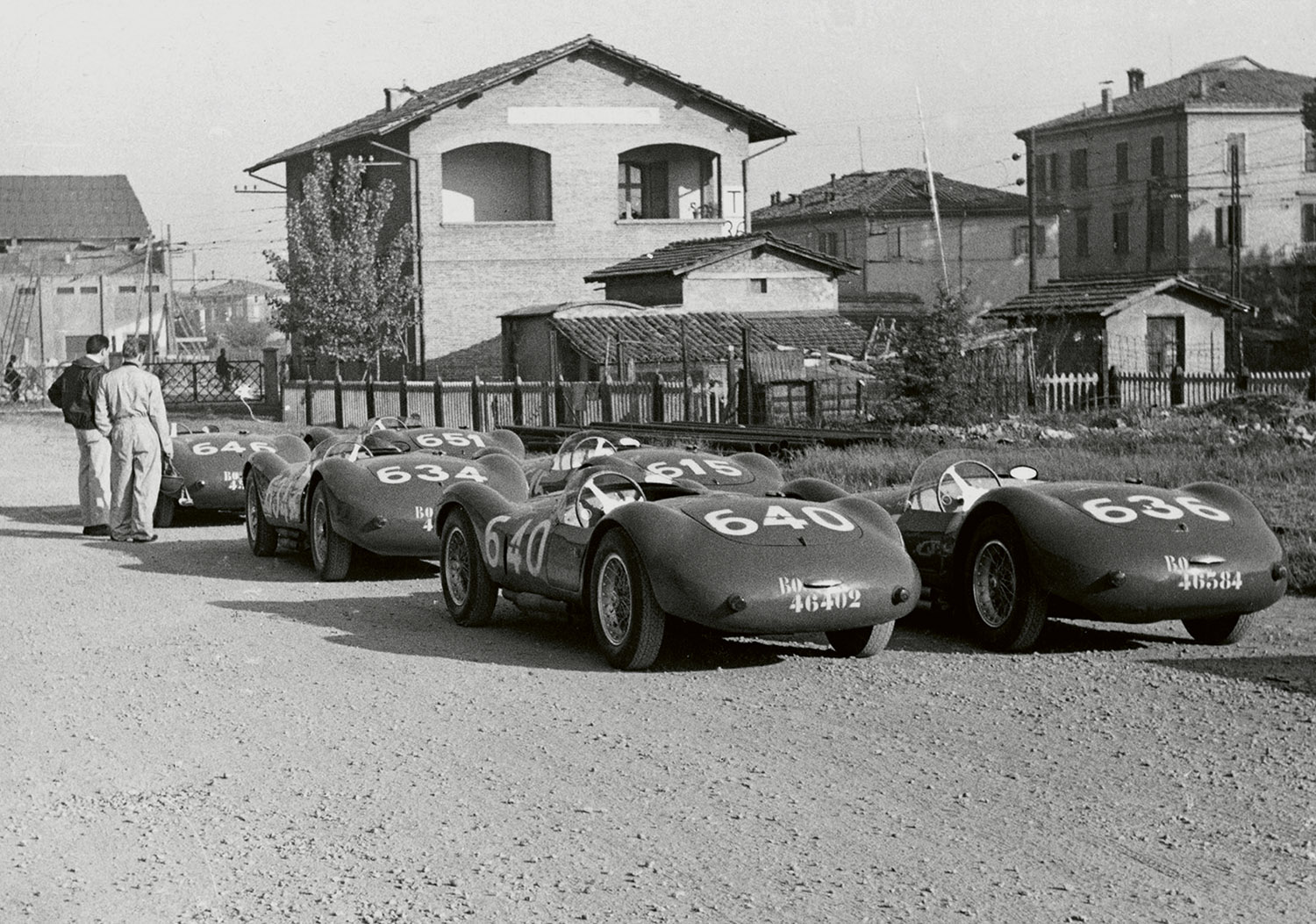
Maseratis are being readied for participation in the 1955 Mille Miglia. This is the backyard of the Maserati factory.
The text for each serial number includes a history of the car, most of the owners, major events and a list of all the events each car entered during its competitive life. We noted that the authors in many cases did not list the owner’s names, past or present, using a brief description to indicate who the person may be, i.e., the head of a large hotel chain, etc. Says Bäumer, “Some of the owners do not want to see their name published. I respected that from my first book on and we did so with this project as well.”
And owners he knows. For Bäumer and Blachette, producing these books is a labor of love…no one is going to make any serious money on books. But the books do help support his full-time job, researching Maserati histories for owners and buyers and brokering the sale of Maseratis. Here is a link to Bäumer’s website: www.internationalmaseratiresearch.com/
For such a book to support his daily bread, Bäumer and Blachette might well have been satisfied with publishing the stats, results, and a few perfunctory photos. But here is where this book is different – different even from the A6G 2000 and A6G 2000 Zagato. They are all large format books, and all have great historical photos. But with the A6GCS volume, much of the photography is not just great but astounding. Many of the 343 photos are well balanced, in full focus with no loss of depth of field, even contrast, superb resolution, even when enlarged to the full 11.5 by 11.5 page size. The subjects are evocative, a graphic depiction of the era, the people, the foibles: Portago stands by his Maserati, confident but yet unsure; the one and only Vignale A6GCS broken in a farmer’s field….
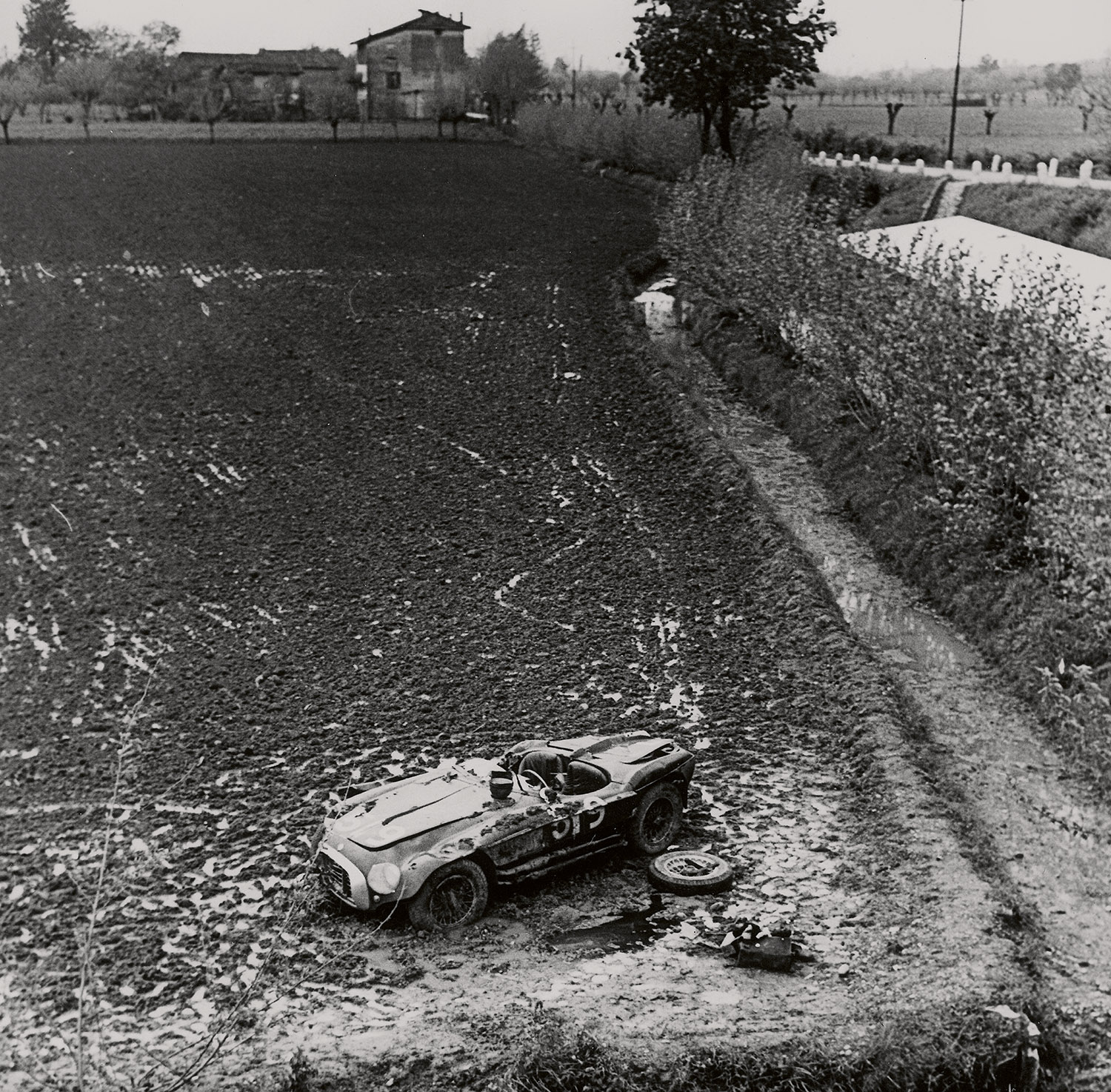
Tony Parravano lived in Italy in 1953 and ordered a new A6GCS with a body by Vignale, penned by Michelotti. He lent or leased it to Guido Mancini who entered it in the 1954 Mille Miglia. He left the road and his co driver Silvio Dal Cin was thrown out and killed, the car coming to rest in this field.
Writes Bäumer, “As an ex-fashion photographer and free-lance Art Director I always spend much attention to the images. For me a book is – next to its research facts and details – always also a kind of entertainment. It must look good. Too small photos are a No-Go for me. Therefore, I do my own layout and design. I spend much attention on the atmosphere of the period; pictures that are uncommon. It does not make any sense to use too many photos of a car standing on the Mille Miglia ramp in Brescia or crossing by. Action shots of cars were very welcome of course but the big task was to find photos of race venues like GP Naples, Ollon-Villars, Reims and the numerous hillclimbs that are forgotten today. The photos I use are either very rare or they must fit perfectly in the layout context of my books. Jeff and I combined our photo archives for the book and a huge task was to choose which photos to use and which we did not want to use. We both have many more images than shown in the book. But to use more of these remarkable photographs with the high quality layout you see would have made the book too thick and heavy.”
We have noted that some reviewers complain that there are not enough photos in this series of books that show the cars as they appear today. There are many reasons for this. First, Google any chassis number and one will find dozens of current or recent photos of any particular car. Second, publishers and authors are held to a different copyright standard than private individuals using Facebook or Pinterest when using photos; each one must be credited, the photographer notified and paid as necessary. That’s the law. It is far better to legally purchase or request rights to historical photos than to waste pages (each additional page leaf costs extra) and money on photos that can be found on the Internet. Lastly, sending a professional photographer around the world to shoot each car is simply out of the question.
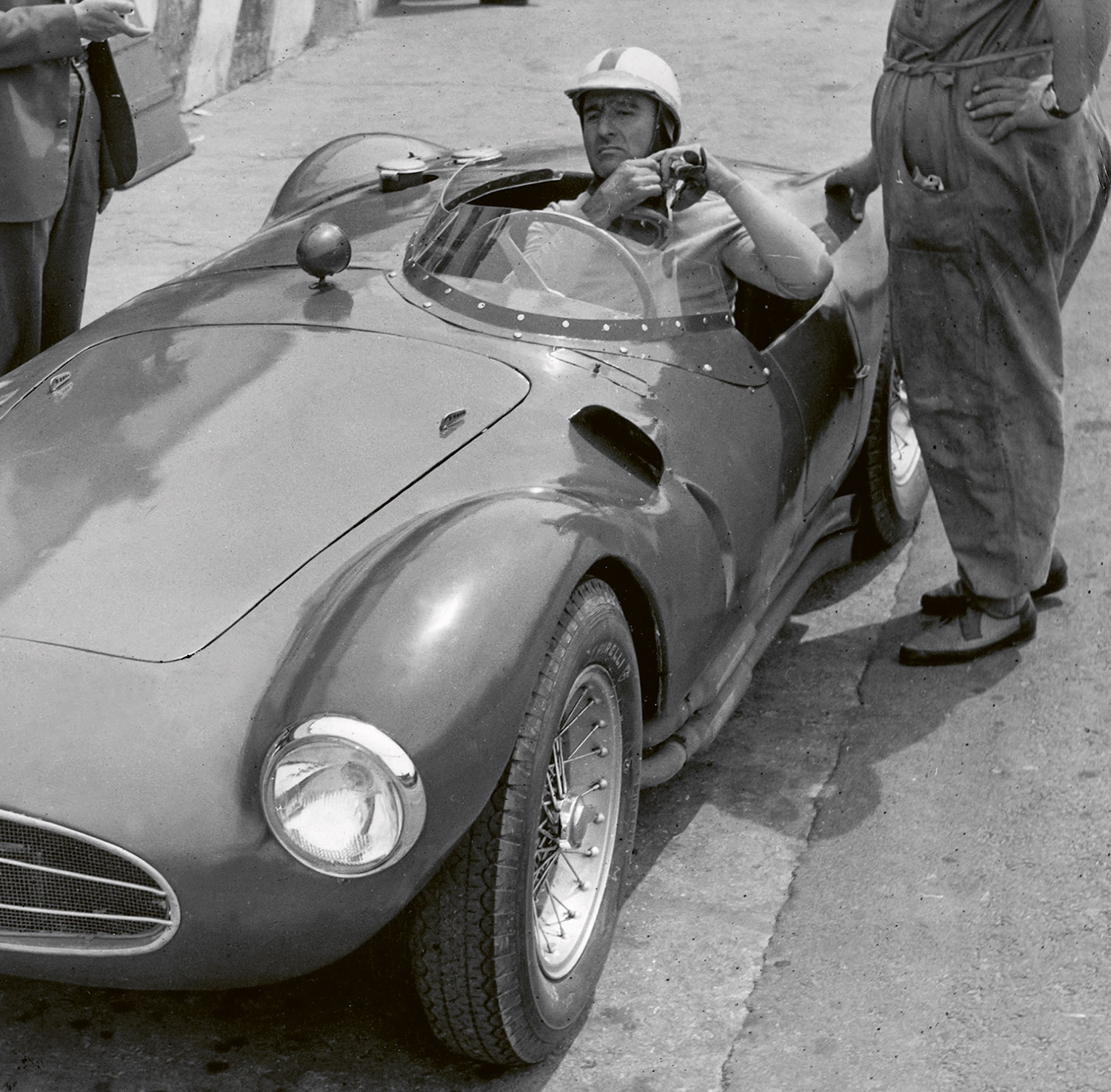
A bit of a mystery car, but here the driver is Giuseppe Farina, who did not drive the car in the event. The place was Monza, June, 1956.
Model names explained
First, we’ll quote from Anthony Pritchard, writing in Maserati, a History, Arco Publishing, 1976. “The ‘A’ indicated the basic family to which the models belonged; the ‘6’ indicated the number of cylinders, while the ‘G’ represented ‘Ghersa’ meaning that the cylinder block and crankcase were cast iron. Illogically, the ‘G’ was retained in the designation of the 1952-3 single seaters and the A6GCS cars of 1953 onwards, even though these featured aluminum cylinder block. “ The ‘C’ was for Corsa while the ‘S’ was for Sport and the ’M’ for Monoposto when defining the A6GCM F2 cars.
The model featured in this book, according to Bäumer and in the factory brochure, was given three new types of designations: Maserati Sport 2000, A6GCS, and A6GCS/53, but for consistency reasons the authors use the name A6GCS.
The factory further confused the issue with the A6 road cars. They used A6G 2000 on some, and when the twin cam head was introduced to the road cars in 1954, they were often called the A6G/54, except for the Zagato bodied cars which apparently stuck with A6G 2000. Don’t ask if they still had an iron block.
If you are reading this, you love Maseratis, particularly early Maseratis. Buy the book, and buy all three if you can. We don’t claim they are perfect, only perfectly essential.
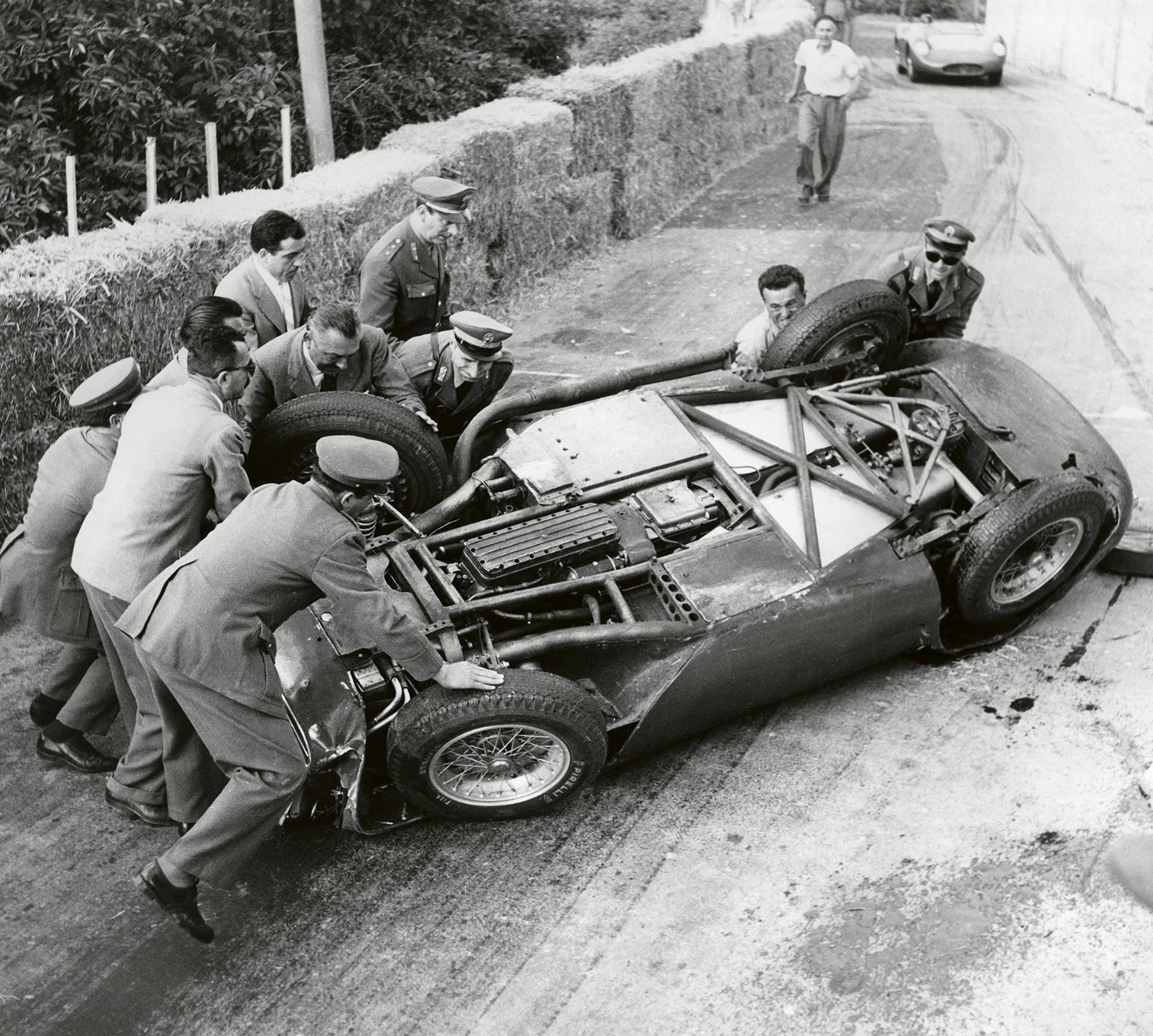
Bäumer searches for interesting photos, this one of chassis 2061 from a point of view rarely seen after driver Renzo Cigarini rolled a the 1957 Bologna-San Luca Hillclimb. Renzo had only minor injuries.
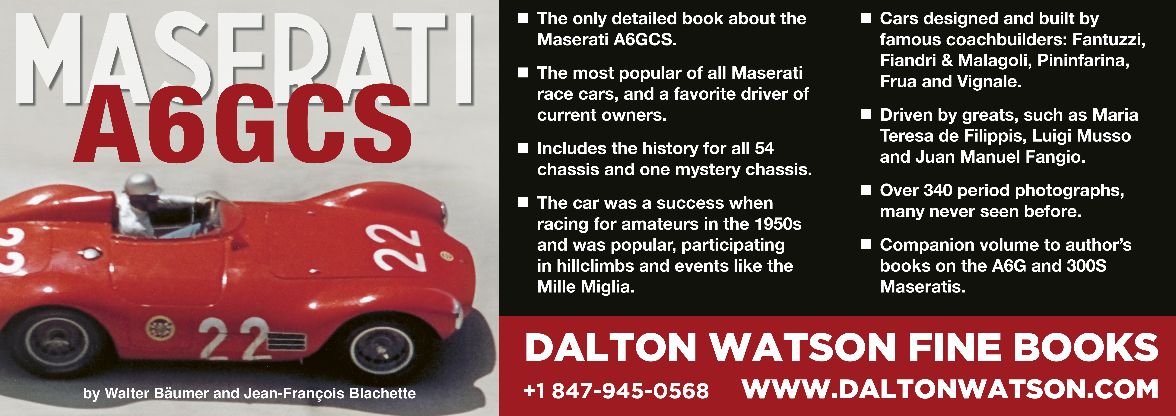
Maserati A6GCS by Walter Bäumer and Jean François Blachette
Pages: 400
Images: 343
The only detailed book about the Maserati A6GCS
The most popular of all Maserati race cars, and a favorite driver of current owners
Includes the history for all 54 chassis and one mystery chassis
The car was a success when racing for amateurs in the 1950s and was popular, participating in hillclimbs and events like the Mille Miglia
Cars designed and built by famous coachbuilders: Fantuzzi, Fiandri & Malagoli, Pininfarina, Frua and Vignale
Driven by greats, such as Maria Teresa de Filippis, Luigi Musso and Juan Manuel Fangio
Over 340 period photographs, many never seen before
Companion volume to author’s books on the A6G and 300S Maseratis