
The story began on 1st December 1914 when the Societa Anonima Officine Alfieri Maserati was set up in Bologna in what was little more than a garage run by motoring enthusiasts who had a tradition of superlative craftsmanship and a passion for cutting-edge engineering, a combination that has produced the Maseratis we know today.
In the early days, the Maserati brothers merely modified the luxury Isotta Fraschinis of the day for road racing. In fact the first true Maserati, the Tipo 26, did not emerge until 1926, when it won its class in that year’s Targa Florio. A year later Maserati won the Italian Constructors’ title and Ernesto won the Italian drivers’ title.
The rapid rise to engineering and racing supremacy was celebrated in magnificent style in 1929 when Maserati shattered the world speed record over 10Km with a speed of 246Km/h (153mph). The car was the V4 powered by an amazing 280 bhp 16-cylinder 3961cc engine and was driven by Baconin Borzacchini. The same combination racked up Maserati’s first Grand Prix victory at Tripoli a year later.

Meanwhile the Maserati operation expanded in all directions: the first Maserati Grand Tourer with a Castagna body made its debut at the Milan Show in 1931, the same year that Count Theo Rossi di Montelera employed a Maserati engine on his power boat, the Montelera XII which went on to win the world water speed record, the first of a long series of Maserati successes in the power boat sector.
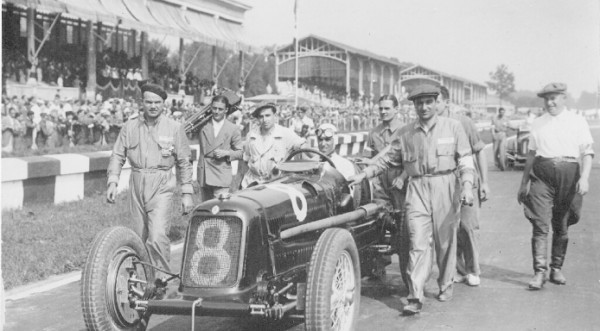
On land, Maserati’s “little” cars were winning races on tracks all over Europe and the brand was rapidly gaining a reputation for advanced engineering. Among its innovations, the world’s first hydraulic brakes appeared on the 8C/8CM in 1933 (that was the car that Giuseppe Campari drove to victory in the French Grand Prix and Tazio Nuvolari did the same in the Belgian and Nice Grand Prixs.) 1934 bought another world speed record (222km/h – 138mph) in the 1100cc class: the car was the 4CM, the driver Giuseppe Furmanik.
In 1937 the Maserati brothers handed over the financial management of their company to the Orsi family, while keeping their hands on the engineering side. That opened the way to operations on a much broader front, which bore fruit in two successive wins, in 1939 and 1940 in the Indianapolis 500 (by Wilbur Smith in an 8CTF). In 1941 the Maserati was in the lead when it was forced to retire and privately entered Maseratis finished 3rd and 4th in 1946. That made Maserati the first (and so far the only) Italian constructor to win the legendary American race. Meanwhile, in 1939, the firm had moved to its now celebrated premises on Viale Ciro Menotti in Modena, where its extraordinary creativity was deployed in the service of the Italian war effort as it converted to the production of machine tools, electrical components, spark plugs and even electric vehicles (a battery powered truck and van appeared at the Milan Trade Fair in 1942). Once the war ended, Maserati got back to its normal business, creating the A6 1500 Sport around which Pininfarina built an elegant coupe body. The racing version was the A6GCS, a highly original streamlined barchetta with offset engine and motorcycle – type wings separate from the body, which Alberto Ascari drove to victory on its first outing at Modena.
But if these were the years of a Maserati revival, they also saw the arrival ofa powerful new rival in Ferrari that launched an exciting all-Italian dual on the race tracks all over the world. In 1953 the Maserati A6GCM 2000 with Juan Manuel Fangio at the wheel came second in the World Championship behind Alberto Ascari in a Ferrari. 1954 saw the debut of the legendary Maserati 250F with a 2500cc 6-cylinder engine and transverse rear-mounted gearbox in unit with the differential. This was the car that started out by winning Fangio the Argentine Grand Prix and subsequently the World Drivers’ title.
At the same time, several A6G spider and coupe models with bodies by Frua, Allemano and Zagato came out. In 1955 an aerodynamic 250F with a wraparound body was created for the Italian Grand Prix at Monza. In the meantime Maserati was experimenting with advanced engineering systems like disc brakes and fuel injection. Maserati bought its Grand Prix career to a glorious finale in 1957 at the end of a triumphant season which started out with the first three places in Argentina and ended with Fangio’s world title in the 250F. That same year Maserati designed a 12-cylinder 2500cc engine for Formula 1 and previewed the 3500GT 2+2 seater sports coupe at the Geneva Show. It was the start of a new ear for the Trident badge. The 3500GT remained in production until 1964 and was responsible for introducing a whole series of important innovations, such as twin-plug ignition systems, disc brakes and fuel injection, to ordinary road cars. Even the departure of the official Maserati team from racing did not end the firms interest in motor sport and in 1958 it launched the Tipo 60-61, nicknamed the “Birdcage” after its revolutionary chassis that was constructed out of a trellis of slender tubes. When a special 500 mile invitation race was organized on the Monza high speed track for Indy specialists, Maserati was there with a special car (the Maserati Eldorado) with a V8 engine driven by Stirling Moss.
The same engine, in different capacities and states of tune, also appeared on the 450S powerboat that ruled the waves in its day and also powered the prestigious 5000GT with Touring body that was created for the Shah of Persia and appeared at the Turin Show in 1959. In the sixties, Maserati expanded its GT operations as the Sebring (the final development of the 1962 3500GT) was followed by the Mistral in 1963 and the luxurious Quattroporte, which made its name as the fastest saloon in the world. However, while officially retired from racing, Maserati had not stopped engineering racing cars, which included special berlinetta models for the Le Mans 24 Hours (the 151 of 1962), the sport Tipo 65 with its rear mounted engine and the highly original transverse V12 engine it created for the formula 1 1500. In 1966, the Ghilbli coupe, the first Maserati entirely designed by Giorgetto Giugiaro, went into production and a new 3-litre 12 cylinder Formula 1 engine was developed. In the first year of the new formula, the Cooper-Maserati driven by John Surtees won the Mexican Grand Prix, as well as taking second and third places in the World Championship.
In 1968, Maserati turned out a record 733 cars and acquired a new shareholder in Citroën. That same year, it launched the Indy 2+2 coupe and started production of the new V6 engine that was to power the revolutionary Citroën SM which went into production in 1970.
At the 1971 Geneva Show, Maserati launched the Bora, a two-seater, mid-engined Grand Tourer and then a year later, the Merak 2+2 seater utilising the V6 engine first seen in the Citroën SM. The SM won the Moroccan Rally, giving Maserati its first ever rallying success.
In 1975 the effects of the oil crisis forced Citroën to draw in its horns which meant abandoning Maserati, which was sold to Alejandro De Tomaso’s GEPI. Under its new management, the firm produced a 2000cc version of the Merak and in 1976 it launched a new version of the Quattroporte which went on to become the bestselling Maserati of all time and the car used by successive Italian presidents on official occasions.
The eighties bought many changes, not least the creation of a model destined for mass production. This was the surprising Biturbo, a performance saloon with a 2000cc V6 engine that was launched in 1981. In 1984 an impressive 6,000 Biturbos were constructed. Further development of the turbocharged V6 engine led in 1989 to the launch of the Shamal that featured the first Maserati V8 engine to adopt twin turbochargers. In 1993 Fiat Auto acquired the entire share capital of Maserati which was put under the full control of Ferrari on 7th July 1997.
Work began on the new Maserati factory on 1st October 1997 and the Quattroporte Evoluzione came out in 1998. That same year, the 3200GT was launched at the Paris Motor Show. It was both the first Maserati of the new era and a revival of a 4 seater Grand Tourer tradition that began forty years earlier with the 3500 GT. The 3200GT was followed in 2001 by the new Spyder, based on a re-worked 3200GT floorpan but featuring a shortened wheelbase and an all new 4200cc normally aspirated V8 engine and a transaxle gearbox. This new engine and running gear together with a number of styling changes were carried over from the Spyder, launched at the Frankfurt Motor Show in September 2001, to the Coupe that was launched at the Detriot Motorshow in January 2002.
September 2003 saw the launch of Maserati’s majestic new Pininfarina-designed Quattroporte, a curvaceous yet aggressive-looking, big, five-metre long saloon that hailed the rebirth of the ‘Italian flagship car’. In March 2004, the 74th Geneva International Motorshow saw the unveiling of the long-awaited MC12 and GranSport models.
To celebrate Maserati’s 90th Anniversary, the Modenese company presented a new, limited edition model. Featuring a new Blue Anniversary livery, the Spyder came equipped with a bodykit comprising of sports bumpers and underdoor sills.
While Maseratisti from all over the world assembled in Modena and Rome to celebrate Maserati’s 90th anniversary, at Oschersleben in Germany, Maserati raced to its first international race victory since 1967 when Mika Salo and Andrea Bertolini, driving the sensational new MC12, won the 9th round of the FIA GT Championship.
The Geneva Auto Show of 2007 saw the worldwide debut of a new model, the long-awaited Maserati GranTurismo, styled by Pininfarina, it is the latest addition to the Maserati stable, followed in 2013 by the latest incarnations of the Quattroporte & Ghibli featuring in the line up the first diesel engines in a Maserati.
Article reproduced courtesy of Antonio Ferreira, Maserati S.p.A. press office.