
PHOTOGRAPHY BY MICHAEL WARD
After a long hard day sitting on the Peacock Throne, ruling Persia, there was nothing Mohammad Reza Shah Pahlavi liked better than a quick blast in one of his collection of exotic cars, to blow away the cobwebs. A devout Maseratist, and a regular visitor to the Modena factory, it occurred to him one day in 1958, after a (probably hair-raising) ride with the company’s mercurial test-driver, Guerino Bertocchi, that the standard-issue, six-cylinder 3500GT, whilst fine for the plebs, would better befit an emperor such as himself if it had a V8 engine and…oooh, what, five litres?
The seed of the idea came from Maserati themselves, who presented the Shah with all their usual sales blurb, including a brochure for the bedevilled 450S sports-racer. To describe the 450’s career as chequered would be more than a tad ironic, since they rarely lasted long enough to see that particular flag. Beautiful to behold and brutally quick, these 400bhp monsters were blighted by poor reliability and sheer bad luck, culminating in a disastrous farewell performance at the Venezuelan GP, in November 1957, where both 450s entered were destroyed, one of them in a collision with the team’s third entry, a six-cylinder 300S.
It cost Maserati any chance of winning the lucrative World Sportscar Championship, and despite having already clinched that year’s Formula One title, this, plus new and disadvantageous FIA rules for the 1958 season, triggered their decision to withdraw from motor racing entirely. One immediate consequence was a surfeit of unused V8 engines, so the Shah’s request for a more muscular gran turismo couldn’t have been better timed for the beleaguered folk at Viale Ciro Menotti.
But the all-aluminium 450S engine, designed by chief engineer Giulio Alfieri, was an uncompromised racing lump not ideally suited to relaxed, luxurious grand-touring. Its four overhead camshafts were helical gear-driven, its eight pots boasted two plugs apiece serviced by two Marelli distributors, and four 45mm Webers supplied the juice. It was something of a wild child, delivering 400bhp at 7200rpm, and Alfieri’s first task was to calm it down a bit for road use. Initially, this involved changes to the valve timing, dropping the compression ratio from 9.6:1 to 8.5:1, and stretching the bores from 93.8mm to 98.5mm, raising displacement from 4478cc to 4938cc. The 450 thus became a 490 (but 500 sounded better) still with a handy 340bhp on tap at a more civilised 5800rpm.
As to the rest, the new mega-Maser was to be based on the underpinnings of the 3500GT – a tubular steel ladder-frame chassis (suitably strengthened), an independent coil-sprung front end, a leaf-sprung live rear and front disc/rear drum braking. Conversely, it had to look completely different, and shout ‘I’m not a 3500!’ Bertone was Maserati’s designer of first choice, but the Shah rejected their offering (penned by a youthful Giorgetto Giugiaro) and the baton was passed to Carrozzeria Touring, where Carlo Anderloni’s design earned immediate imperial approval. Once the Shah had his car, it was whisked off peremptorily to Tehran, unseen by the world at large.
But with the ball now rolling, Maserati built a second, virtually identical example which they exhibited at the Turin Show in 1959. And that’s when it got serious, as the world’s wealthy formed an orderly line – especially after the publication of a report by American journalist Hans Tanner of a trip taken with Bertocchi in the second car, during which he timed it at 172mph (almost inconceivable 55 years ago) on the Modena–Bologna autostrada. (It’s the second most famous anecdote concerning the 5000GT’s mythical top speed, but the most believable. We’ll come to the other in a minute…)
The 5000s all have even chassis numbers, and the Shah’s car (no.002) and the Turin Show car (no.004) effectively constitute a ‘first series’ (now known as the ‘Shah Of Persia’ cars), since, with a limited production run now in prospect, Alfieri decided that a more radical re-think of the engine was called for. Entirely new bore/stroke dimensions (now 94mm x 89mm, giving 4941cc), replacement of the gear cam drives by chains, and of the big Webers by Lucas fuel injection resulted in a slight drop in power (now 325bhp at 5500rpm) but further enhanced driveability. In this configuration, the V8 powered a further 32 ‘S2’ cars, whilst five-speed gearboxes and rear disc brakes were also progressively adopted. As if to underline the changes, body design was now farmed out to a variety of carrozzerie…
5000GT Chassis No.103.026
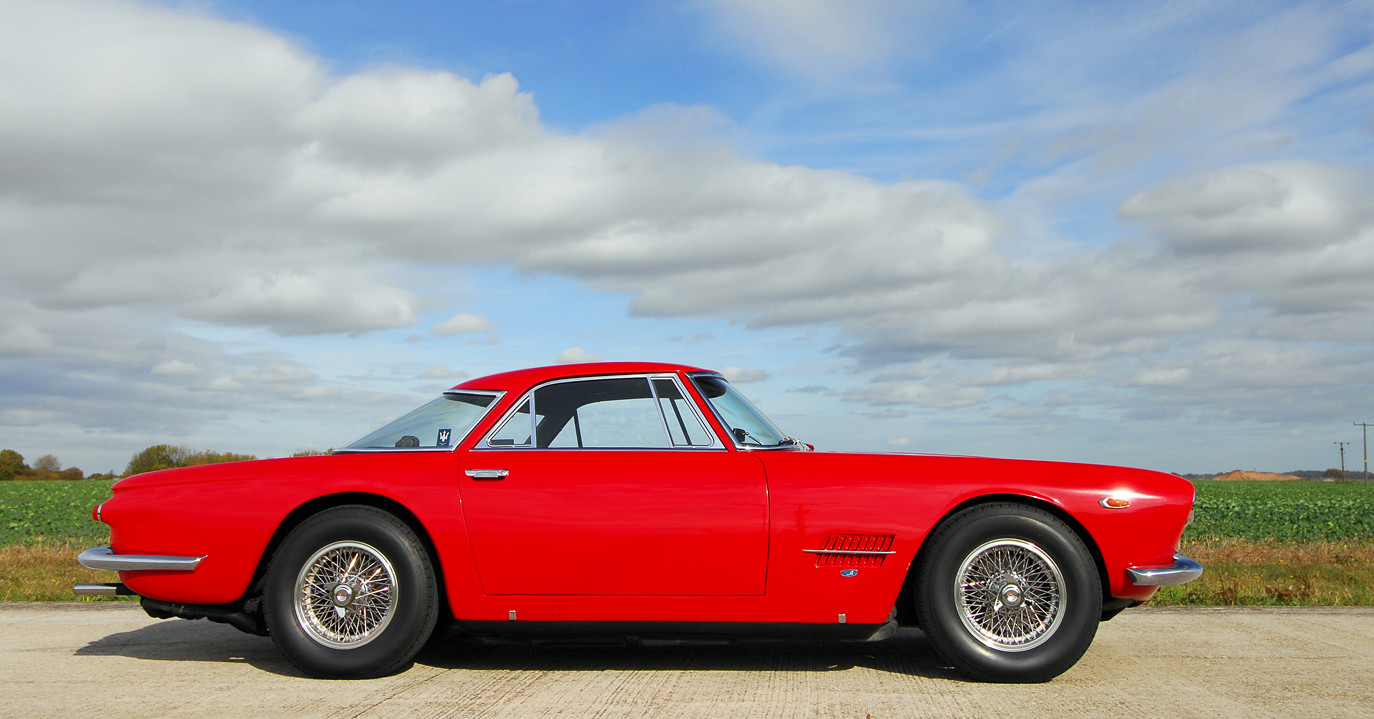
Of the 34 cars built, 22 had bodywork by Allemano, drawn by Giovanni Michelotti, of which chassis no.026 – laid down in early 1962, but not commissioned until the following year – was the fifth. It was pretty much a last hurrah for the company, which folded in 1965 – but what a way to go. Minor differences aside, all 22 looked basically like this, so it’s effectively the ‘standard’ 5000GT shape.
Okay, let’s get it over with…026’s second owner was erstwhile Eagles strummer Joe Walsh. Yep, this is the one – ‘My Maserati does 185’, etc (from ‘Life’s Been Good’, 1978 – 99p from iTunes). Well, actually Joe, no it doesn’t. The highways and byways of Bedfordshire aren’t good places to ‘max’ a Maser but, aerodynamic and power/weight ratio considerations aside, such a velocity would have the V8 spinning to its grave. But, hey, it’s only rock’n’roll… By the early ’90s it was owned by a Ken McBride, from Seattle, and featured in the 5000GT class at the Pebble Beach concours in 1999. UK collector Ian Wade acquired it in the early 2000s and Stephen Dowling has owned it since 2008.
This is a car for kings, and looks it, sitting imperiously in the middle of McGrath’s workshop amidst a motley selection of lesser Masers, hovering like respectful courtiers. The Allemano’s perfectly proportioned design is impressive from every angle – that Studebaker-style rear window gives it a particularly purposeful look from behind – and its generous glazing ensures a light and airy interior, with terrific visibility. The doors accommodate two quarterlights, each with its own knurled chrome wheel, and inside it’s the quintessence of ’50s/’60s chic.
After a quick pre-flight briefing – Mr Lucas likes a quick snort of choke when he’s cold – we embark on a 20-mile run to the photo location. Negotiating McGrath’s slightly awkward exit is a daunting prospect in any biggish car, never mind one as valuable as this; but thereafter the cinquemila proves an engaging, stress-free drive. A quick look around the office confirms pretty standard instrumentation, and switchgear from the ’60s Italian ‘scattergun’ school – but I’ve seen worse. There’s a period Motorola radio, too, but I couldn’t find the electric aerial switch, so all I got was white noise. The front seats are very comfortable, but – typical of the period – lack lateral support. Behind them, it’s the kindergarten…
But it’s all eyes to the front as we hit the A1, heading north, and the Maser’s bulk, initially intimidating, seems to evaporate. Now, too, come the first inklings of what this road-going battle cruiser can really do, as finally I can open up the taps, unleashing a typically seamless surge of Maser V8 power. The noise is fearsome, but neither unpleasant nor unduly intrusive (wind around the doors is more so), and the acceleration awesome – and very un-1960s. To someone used to the V8’s Weber-fed descendents the smoothness and responsiveness imparted by the Lucas injection is a revelation – it blips like a racer, with negligible flywheel inertia.
There’s no line on the 8K rev-counter, but prodigious torque ensures that four thou in any of the ZF’s long gears is more than enough to keep impertinent rep-spec Bimmers and white van bandits in their place. The five speeds (bottom four in the ‘H’) are initially tricky to pin down, and it’s easy to beat the synchro on 3rd, in particular, going up; but a cushioning blip is all that’s required, and it all soon falls into place. I’ve used heavier clutches (but not many) and the non-vented discs feel slightly dead (and might be a worry at 170mph…).
On to smaller roads, and I’m expecting to work harder; but the steering, which required concentration on the faster stuff due to the light caster action, here becomes far more positive, allowing pin-point placement of the nose through bends. Gearing is just right and there’s far less ‘weighting up’ than in most contemporary supercars as lock is applied. Only at parking speeds do you long for some power assistance. It has an astonishingly sporty feel for such a big, 50-year-old car. The ride is superb, and devoid of harshness – oh for a return to nice tall tyres – without demanding too high a price in top-heavy floppiness, despite the considerable weight. The basic mild understeer is easy to counteract to great effect with your right foot, the big Pirellis are nicely progressive, and it’s a complete hoot on fast A-roads. Push too hard, though, and that live back end would step out fast enough to demand – and guarantee – your immediate attention…
But the car of kings was never designed to be a balls-out racer; rather, a relaxed ‘grand tourer’ – never was that over-used tag more apt – for roaming the new, thinly-populated motorways of continental Europe half a century ago. To have spent a few hours driving a 5000GT was a rare privilege; in her day she was the fastest and most expensive car on the planet, the plaything of emperors, tycoons and rock stars – rare, exotic and queen of all she surveyed. And, as the Bard nearly said of another old queen, age has not withered her.
Thanks, again, to Andy Heywood for making the car available (and answering all the questions!)