
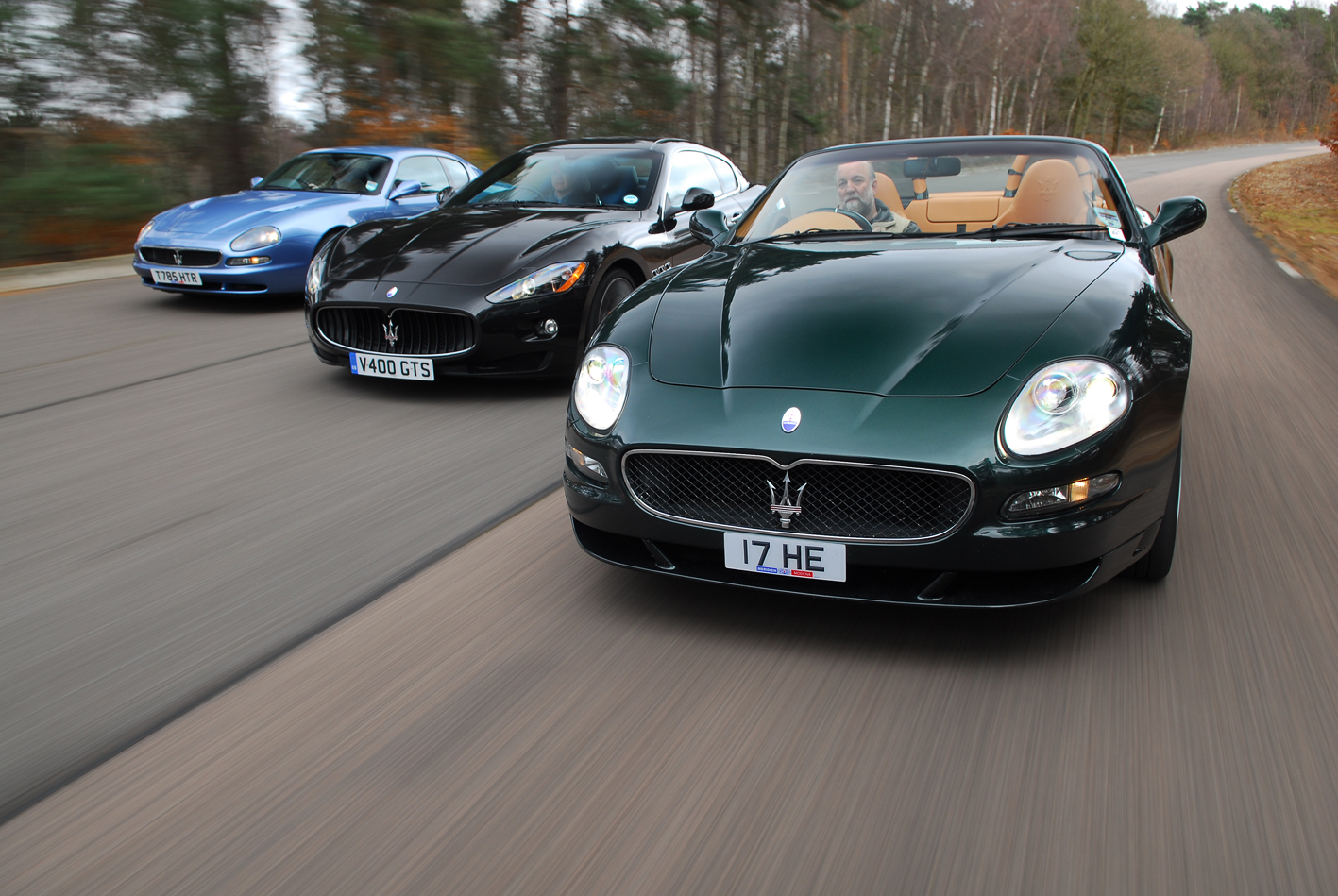
PHOTOGRAPHY BY MICHAEL WARD
Who could have imagined only a decade ago that Maserati would have undergone this kind of renaissance? During the first two thirds of the 1990s, the Modenese company produced a few handfuls of specialist cars that appealed only to fewer handfuls of enthusiasts. Journalists who cared about the great name labelled the cars idiosyncratic and eccentric; those who didn’t were less charitable. There were high points, such as the Shamal and the Ghibli Cup, both of which still have that specialist following. However, neither were produced in large numbers, and in the case of the latter less than 100 cars – nowhere near enough to stem the seemingly inexorable demise of the company.
Indeed, while Maserati had been fully assimilated by the Fiat Empire in 1994, its influence on the future of the company would be a further three years coming and, when it finally did arrive, it was with a shock for the cognoscenti. The old rivals down the road at Ferrari were to join forces with the Trident to share development costs, production facilities and technical know-how. If that raised a few eyebrows, they needn’t have worried. The car that heralded a return to form was pure Maserati, a lithe Coupe with a fearsome, gutsy V8 and a beautiful body designed by Giugiaro – the 3200GT.
At the time, Maserati understandably presented the car as an all new design and a product of the new alliance with Ferrari, but the truth is not quite so clear cut. Giugiaro’s work had been sitting on the drawing board at Maserati for some time awaiting the capital to produce it and, as well as that, the V8 engine had more to do with the preceding era than anyone cared to admit.
The 3.2-litre twin turbocharged V8 engine that powered the 3200GT was a development of the previous Shamal engine, itself a development of the original V6 Biturbo concept. Of course, the 3200 engine benefited from advances in fuel injection and turbo management including a fly-by-wire throttle, so even with the same capacity it produced 370bhp against the earlier car’s 325bhp. A hybrid of these two engines found its way into the Quattroporte IV series that was sold alongside the new car.
In all other respects the 3200GT was a huge step forward. All aluminium double wishbone suspension and adjustable shock absorbers replaced Biturbo era MacPherson struts, whilst dedicated four-pot Brembo brake calipers and large ventilated discs all round replaced the parts bin mixture of components that had gone before. Even air bags and traction control became standardised for all markets.
Traction control was certainly something the 3200GT needed as many owners soon found out. Careless use of the ultra sensitive throttle sent the V8 into convulsions and if the car wasn’t pointing broadly straight then progress was likely sideways. The hair-trigger throttle also made manual versions difficult to drive around town as matching the clutch to the throttle required considerable patience and skill. Because of this, the Australian sourced BTR automatic gearbox became far more popular than the Getrag six-speed manual.
While the shape of the 3200GT was a departure for Maserati, it was reminiscent of the car’s two main competitors, the Jaguar XK8 and the Aston Martin DB7. To have even been considered in the same sentence must have pleased the Maserati management and in this respect the 3200GT acquitted itself well. Giugiaro had given the car an elegant Italian suit of clothes with little unnecessary detail but a hugely distinctive rear light treatment that looked set to become Maserati’s new calling card.
From 1999 to 2002, the 3200GT became the mainstay of Maserati production. That it had been developed quickly and using some previous ideas did not really show and allowed the company to redevelop its factory and dealer networks in readiness for the next stage of the comeback – a return to the North American market.
Not since 1989 had Maserati sold new cars in the USA, De Tomaso famously pulling out of the largest market in the world because of the relentless litigation he faced from disgruntled Biturbo owners. However, for any serious prestige car manufacturer in the twenty first century it was a crucial market and Maserati knew that the 3200 was not good enough to face the Americans. For a start, the turbocharged engine would not pass strict US emission standards (and in fact the soon to be tightened European ones), a legacy of its true age.
The new engine that resulted developed 390bhp from 4.2 litres. It was still an all aluminium four cam V8 but normally aspirated and very different in character to the old blown lump. For the first time ever, a Maserati production engine revved past 7000rpm and did most of its best work at higher revs, instead of in the torquey mid range. Maranello’s influence on the Trident was now at its height.
The car into which this engine was fitted was called just plain ‘Coupe’, although why Maserati did not foresee the obvious 4200 moniker that has been universally accepted since remains a mystery. At a glance the Coupe only differed from the 3200GT in detail. The difficult to align front bumper had been re-designed so that the panel breaks were between the headlights and the bonnet, rather than right across the nose. The bonnet air vents so necessary for cooling the turbochargers were deleted. Surprisingly, the boomerang rear lights were also deleted in favour of a much more traditional design. “Blame the American customer clinics” Maserati said at the time, but in reality all of these changes were about making the car easier and ergo cheaper to make and repair.
The real changes were under the skin and were all about balance. The engine had a dry sump system that allowed the engineers more flexibility as to how to install it. They chose to place it behind the front axle line and in turn moved the gearbox to the rear, between the wheels. While the result was undoubtedly well balanced, it did present some other problems. No longer was it possible to use the BTR automatic gearbox, even though the 3200 auto had far outsold the manual. Instead, a six-speed manual transaxle and a robotised manual became the only options. It defies belief but Maserati had just ignored the majority of their customers and in addition were proposing to re-enter the States without an auto option.
This was Maserati’s first use of a robotised manual gearbox, which they called Cambiocorsa, and although the technology had already been in use with Ferrari and Alfa Romeo for some time, it was a long way from being perfected. The main talking points of the 4200 became not only the new ‘Ferrari’ engine but also the tricky paddle shift. In truth the two features were very well matched. An engine that thrives on high revs and a gearchange that responds at the flick of a finger to keep it that way are a great combination. The only problem was that they worked better on the race track than in the clunky stop-start clutch-eating traffic jams in which most owners would more normally find themselves.
In 2004 the 4200 Coupe and its convertible sibling the Spyder underwent a facelift with the unveiling of the GranSport versions. Frank Stephenson was then head of design at Maserati and mildly re-shaped some of the details on what was intrinsically the original Giugiaro shape. The GranSport featured a deeper front grille, extended side skirts and deeper bumpers. The GranSport engine gained another 10bhp through fuel injection and exhaust changes. The gearbox, now Cambiocorsa only, featured the most up to date software available in order to give faster and smoother changes. Brake and wheel upgrades and a more sporting interior completed the transformation. These were all relatively minor changes but ones which turned a good car into a great one. For the committed driver, the GranSport was a return to the kind of form not seen since the Ghibli Cup almost ten years earlier. Yet it still didn’t overcome the need to produce a full automatic. That would only come in 2007, with the launch of the GranTurismo, a completely new car, designed this time by Pininfarina.
If the 3200 was defined by those boomerang rear lights, then the GranTurismo will surely be defined by its grille, a massive gaping hole in the front of the car and a shape inspired by the 1954 A6GCS Coupe, another Pininfarina Maserati. The other aspect of the car that dominates is its sheer size. It makes the 3200GT and the GranSport look small by comparison whereas neither is in reality. This scale is here to stay though, for apparently only the UK and Swiss markets do not link prestige to size.
The main component carried over to the GranTurismo was the 4.2-litre engine but finally Maserati gave their public what they really wanted, a full torque converter automatic gearbox, supplied by ZF. This meant that the gearbox had to be positioned behind the engine. At the launch this was the only option available, but now, with the new GranTurismo S, there is a Cambiocorsa type gearbox mounted at the rear. I can’t think of another manufacturer that moves their gearboxes fore and aft with the regularity that Maserati does!
At the end of the day it is all about the pursuit of perfection. For ten years Maserati has been trying to build the perfect car. Certainly they have taken some wrong turns along the way but there are aspects to each model that are great and they have all shown the promise of what might be to come. Now, finally, it has arrived. The GranTurismo S feels like the end of a journey for Maserati and the culmination of a decade of hard work.
The new 4.7-litre version of the V8 that powers the ‘S’ regains the torque for which Maserati was renowned. It has the grunt of the 3200GT, yet it still revs effortlessly to 7000rpm, where it develops 440bhp. It also has the most intuitive version of the paddle shift, Cambiocorsa type gearbox yet made, with a twin plate clutch and new ‘MC-Shift’ software, plus longer paddles behind the steering wheel that are easier to operate wherever your hands prefer to be on the wheel. This all helps not only with ultimate performance but also with ease of driving round town, even in auto mode. In truth I had begun to lose faith in the paddle shift gearbox, especially as the ZF auto is so accomplished, but this is another world.
While anything that rides on 20in wheels is always going to be firm, the new non-adjustable suspension on the ‘S’ also gives a more sophisticated ride than the rather hardcore GranSport. There is also fantastic balance as a result of the transaxle gearbox and both of these features help with the overall feeling of confidence that one gets behind the wheel, which in turn makes this large car shrink around the driver.
Last but not least, it is beautiful and charismatic, a true GT car shape with all the road presence and glamour that befits a Maserati and equal appeal to both cognoscenti and virgin buyer.
And that’s it. For once there is no downside, no apology necessary, no need for special treatment or patronising tone, no justification to the uninitiated required. The Maserati GranTurismo S is, quite simply, magnificent.